The Approach

The full methodology behind debugging your communication — from first principles to practical application.

Crack the code to human interaction.

You're in a meeting, giving lots of detail to help people see your vision. Instead of the enthusiasm you were expecting, you watch everyone else's eyes glaze over.

Or you're at a conference, coffee in hand, scanning the room. Everyone else seems to be connecting effortlessly. You're calculating the least awkward time to leave.

Or you're pitching your company — the thing you built from scratch — and you can see the investor's attention drifting. You know the technology is solid. You know the market is there. But somehow the story isn't landing, and you can't figure out why.

You know these are solvable problems. You just wish you knew how to solve them. You're constantly wondering why:

  • Products are easy to build and hard to sell
  • Details and data don't generate buy-in
  • Work relationships are filled with friction
  • Attending network events feels like torture
  • Sharing your ideas isn't having the impact you want
  • People overlook your contributions
  • Leadership skills seem so extroverted

You've read books. Watched TED talks. Maybe sat through a corporate training full of hypotheticals that don't match your actual job.

None of it stuck — because none of it matched how your brain works.

What you want is a technical manual for human conversation. A debugger for communication. A way to approach these situations with the same systematic confidence you bring to technical problems.

If this hits home, you've come to the right place.

No, it's not a personality problem.

You aren't too logical. You don't lack empathy. You're not too introverted. What you're missing is a learnable skill.

That's the gap. Not some personal defect. You can build your communication skills the same way you built your software skills.

You learned to code. You learned system design. You learned to debug problems by tracing them to root causes.

But communication? Was that supposed to just... happen? By osmosis? That seems to have worked for everyone else. They somehow seemed to have intuited unwritten rules nobody explained to you.

You watch people navigate politics, build relationships, sell their ideas, close deals, and grow their businesses in a way that seems effortless. How do they do it? How can you do it?

You've quietly wondered: what's the secret to communication that they know and I don't?

Yes, you can reverse engineer success.

Miscommunications are bugs in a human system. Just like you find and fix bugs in your code, you can learn to analyze, understand, and systematically improve your interactions with others.

When a conversation goes wrong, there's a reason — and it's not because you're defective. It's that you haven't built the right mental model yet. But you can. And it might be easier than you think.

Debugging Human Communication is a complete program that applies the structure of scientific discovery through the scientific method to help you crack the code to human communication.

Form a hypothesis, test an approach, and iterate based on what you learn. Get better over time — not through abstract theory, but through real practice, in the real world, with real feedback.

Your technical manual for human interaction

Discover the difference of experiment-driven coaching.

1

Decode Hidden Systems

Communication has patterns, principles, structures — but nobody taught you what they are. You've been trying to navigate without a map.

Once you understand how the system of human communication actually works, things start to click into place. You'll understand what's stayed mysterious to you — why some land and others don't, what's really happening when someone gets defensive, how influence actually builds.

"Andrea understands communication the way I understand code: there are patterns, rules, structure. She sees what I can't see on my own, and helps me build a mental model for whatever I'm facing. What felt chaotic suddenly has structure. Before tactics, she helps me understand myself: what I value, where I stand. Then she gives me a concrete experiment, and the fast feedback loop helps me learn quickly."
— Lada Kesseler Lead Developer, Logic20/20
2

Leverage Experimentation

Understanding isn't enough. You also need an approach you can actually execute.

Instead of forcing yourself into someone else's system, we design experiments around what you're already doing. The goal: find the smallest tweak that creates disproportionate results.

"Andrea's coaching is effective because she helps me spot assumptions I didn't even know I had. She helps me design communication experiments that feel way too easy to have such a big impact."
— Ted M. Young Technical Coach & Creator of JitterTed's TDD Game
3

Get Expert Advice

You won't get handed a one-size-fits-all playbook. Instead, you'll work with a guide who understands the nuance of human systems and can help you design experiments to discover what actually works for you.

Think of it as co-creation: I bring the structure, accountability, and deep expertise — you bring your context and curiosity. Together, we'll navigate the complexity and arrive at solutions that fit your life.

"In my Discovery Session, Andrea immediately spotted a tiny detail in how I could frame my message and sent me peer-reviewed papers to back up her claims. When I tried the experiment, I easily persuaded my stakeholders to hire more people for my team — in a hiring freeze!"
— Soumya Kulkarni MTS, Software Engineering Full Stack
4

Learn in Community

You've probably felt it — the loneliness of being the person who communicates differently. The code-switching. The holding back. The quiet embarrassment of not navigating social situations the way your colleagues seem to.

In this community, you can be yourself. You can share in long detailed responses. You can dive into the detail and be direct. You can nerd out with other people who care about software quality without having to translate your words into business-friendly language.

And you'll discover you're not alone. Others are working through the same challenges — and they're eager to share what's working. Members swap experiments like recipes, excited to let each other in on what they've found.

"Attending my company's annual conference sounded like hell on earth for my introverted self. Instead, it was one of the most rewarding experiences of the last few months and probably a peak of my entire life in communication. Now that I've rested, all I feel is the joy and energy of connection — a weird sensation for an introvert!"
— Ellis Lempriere Associate Software Engineer, OpenSesame

How Small Shifts Create Big Changes

An experiment-driven approach to communication —
designed for how technical professionals actually work.

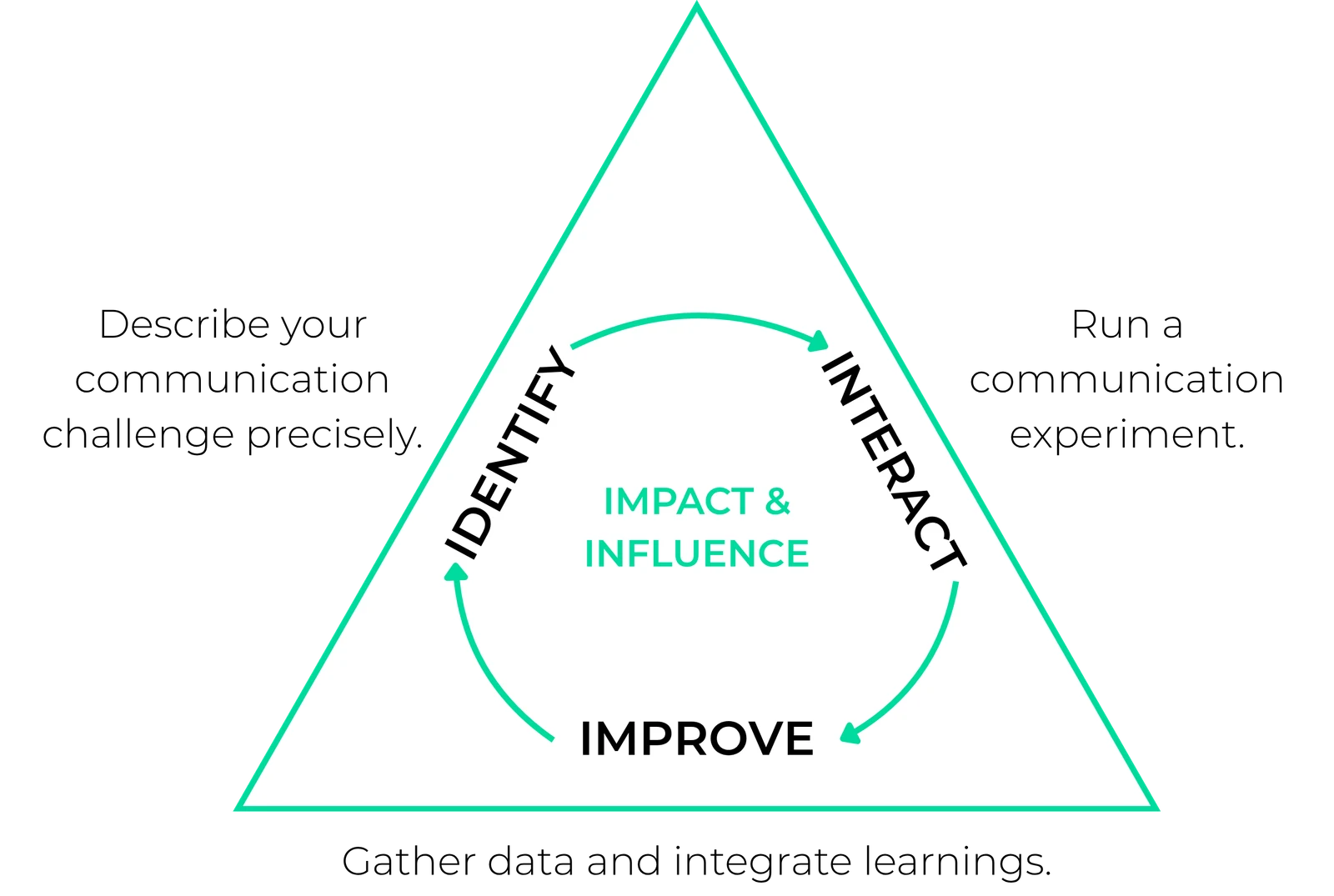
You don't need to overhaul your personality. You need a systematic way to find what's not working and fix it. My eight-step, experiment-driven coaching framework turns real conversations into a lab where you can test, observe, and iterate.

1

Find a Friction Point

Choose one specific challenge. Not "get better at communication" — something concrete, like "my co-worker keeps interrupting me."

2

Gather Context

What conditions shape this interaction? Environment, history, power dynamics, motivation, and more. The nuance matters.

3

Identify Variables

Name the factors you can actually influence with tactical precision. Your word choice, your mindset, your habits, your timing are just a few of many opportunities to explore.

4

Define Success

What does "better" look like, specifically? Not "they get it" — something you can observe like "they ask followup questions."

5

Form a Hypothesis

Predict what a small shift might change. "If I lead with the business impact, then they'll engage with the technical details."

6

Make It Measurable

Decide how you'll know if it worked. What will you watch for? What will you write down after?

7

Run the Experiment

Every tiny interaction is data to test your hypothesis. When things don't go as planned, it's not a failure. It's an unexpected result that helps you learn and spot patterns.

8

Follow What Works

Keep what's effective. Turn surprises into new experiments. Repeat.

This isn't theory. It's a practice. Better communication emerges naturally and compounds over time.

Effort Won't Fix Communication.
Leverage Will.

"Give me a lever long enough and a fulcrum on which to place it, and I shall move the world."

— Archimedes

Most people focus on the lever — working harder, pushing through, saying more. But Archimedes knew the real power is in the fulcrum: where you place it.

That's what we do together. We find your tipping point — the place in your habits, timing, mindset, or messaging where a small adjustment creates outsized results.

Most clients come wrestling with one of these four patterns:

Conversation Flow

You know what you want to say, but it comes out wrong. You rehearse for days, then freeze in the moment. You replay conversations wondering what you should have said differently.


Stock your toolkit with curious questions: 'Help me understand...' 'What's driving that?' 'What would change your mind?' Use them when words fail you.

Stakeholder Buy-In

You have good ideas, but you can't get traction. Whether it's a boardroom, an investor meeting, or an internal proposal — you're told you're "too in the weeds" but nobody explains what the right altitude looks like. The people who should be your biggest advocates aren't buying what you're selling.


Before your next pitch, proposal, or board update, ask yourself: "What problem does this solve that they already care about?" Lead with their problem, not your solution.

Community & Belonging

You feel like you don't fit in anywhere. Networking feels performative and draining. You're tired of code-switching just to connect, and wonder if there's a place where you can just be yourself.


Watch for people who smile, nod, or make eye contact — they're signaling openness. Mirror it back. That small exchange is often all it takes to start a real conversation.

Growth & Leadership

You're ready to do more — whether that's leading a team, running a company, or sharing your ideas to a bigger audience. You want to grow without faking a personality that isn't yours.


Think of a peer or mentor who's navigated a similar transition. Send them a short note. The conversations that reshape your leadership often start with a simple 'I'd love to pick your brain.'

Ready to find your leverage point?

Book Your Discovery Session →

Sample Session Report

Names and identifying details have been changed to protect privacy.

Session Notes: Alex

Date: January 5, 2026 | Duration: ~59 min Attendees: Andrea Goulet, Alex

Overview

Alex spent ~15–16 hours on his blog during the holiday break and feels proud of the progress. The session explored why budgeting 20 hours (vs. 1 hour) shifted his emotional experience from embarrassment to pride, identified a sunk cost fallacy pattern around rabbit holes, and established experiments for estimation and context capture.

Experimental Design

1. Friction Point

Estimating accurately and avoiding rabbit holes that delay launching the blog.

2. Context
Theme Description
Previous session Felt embarrassed about lack of progress when estimating 1 hour for tasks
This session Felt proud after budgeting 20 hours and spending ~15–16
Work blocks Morning sessions continue to be effective; context switching is expensive
Documentation Writing tickets/documentation "doesn't feel like work," contributing to sunk cost trap
Work situation Increased estimation requests at work
3. Variables
Variable Observed Outcome
Time budget (1 hr vs 20 hrs) 20 hrs → pride; 1 hr → embarrassment
Doom scrolling replacement Successfully swapped for blog work multiple times
Breaking work into pieces Easier to estimate smaller chunks
Claude Code for tedious tasks Content import, to-do list generation, redirect script creation worked well
4. Success Criteria
Criterion Status
Blog live In progress
First post published Pending
Proud of visual design Achieved locally
Able to publish new articles Pending deployment
5. Hypotheses
IF THEN
Alex quadruples his gut instinct for estimates He'll avoid disappointment and feel proud of progress
Alex uses Claude Code to capture thinking when hitting a blocker He can avoid sunk cost fallacy and context-switch more easily
Alex breaks big things into smaller pieces before estimating Estimates become more accurate
6. Measurement
Metric How to Track
Actual time vs estimated time Track for each task
Sunk cost trap occurrences Notice when falling in and capture the moment
Blog launch Binary: is it live?
7. Experiment
Behavior Change Expectation
Estimation approach: Before communicating any expectation (external or internal), break the big thing into smaller pieces, apply 4x multiplier to gut instinct, sum the pieces More accurate estimates, less disappointment
Avoiding rabbit holes: When a task exceeds its budget and isn't mission-critical, pause. Capture: goal, blockers, potential solutions. Create WIP commit with to-do list, push to branch, link in ticket Escape sunk cost trap, preserve context without full documentation overhead
Ask: "How essential is this for accomplishing the actual goal?" Prioritize mission-critical work
8. Follow What Works
Past Experiment Effectiveness
Budgeting more time (20 hrs vs 1 hr) Proud vs embarrassed
Morning work sessions Consistent progress
Doom scrolling → blog work swap Successful
Claude Code for tedious tasks Content import, to-do generation, redirect scripts all worked
"If I search and don't find the answer, publish when I figure it out" Content strategy in place

Action Items

Alex:

  • Hide non-essential elements (2 hrs budgeted)
  • Fix broken images in imported posts
  • Complete deployment with staging environment (10 hrs budgeted)
  • Set up redirect links (4 hrs budgeted)
  • Update essential content (remove stock/template text)
  • Write first blog post (favicon generation process)
  • Test everything works (images, RSS, URLs)

Andrea:

  • Post notes in Heartbeat

Planning

Task Estimate
Hide non-essential elements 2 hrs
Deployment + staging 10 hrs
DNS + redirect links 4 hrs
Content updates + testing ~4 hrs
Total remaining ~20 hrs

References

  • Content Collections library — separating content from display
  • Claude Code — content import, to-do list generation, redirect script creation
  • AWS S3 + CloudFront — hosting approach for redirect support

Next Session

  • Did the 4x estimation approach help with both personal project and work estimates?
  • How did the "Claude Code for context capture" experiment go when hitting blockers?
  • Is the blog live? If not, what blocked it?